Massacres in Rutshuru, Kiwandja and Mweso


Massacres in Rutshuru, Kiwandja and Mweso

A PARADISE IN HELL
Over 2008, I travelled on several occasions to the Democratic Republic of the
Congo. In July-August 2008, I visited North-Kivu, and took the road from Goma to
Lubero region in North-Kivu. The road was, and still is arguably one of the most
dangerous roads in the world .
One sees a very beautiful scenery, almost paradisiac mountains with lush forests.
Active volcanos surrounded with magnificent jungles rise all around. In July 2008, while
travelling with a team of the Mission of United Nations in the Congo (MONUC), we
crossed, during a seemingly interminable journey, an area infested with the troops of
the renegade Nkunda(CNDP), the Mai-Mai, Rwandan rebels, the civil militias, the
congolese army (FARDC) and all sorts of armed groups. It was and is a place no one
would like to visit twice.
WOMEN AND CHILDREN PREYED UPON
Along the road, people, mostly Congolese Hutus and Rwandan Hutu refugees,
lived in camps, terrorized, afraid to go back to those paradisiac farms where these
armed groups lurk, ready to kill, ransom, loot, rape women and abduct young boys and
girls. That time, it appeared, from conversations with people selling bananas and other
meager fruits along the road and from camps, that women and children were most
vulnerable, and at the mercy of hoards of CNDP Congolese rebels supported by the
government of Rwanda. Nkunda ‘s CNDP rebels had started to reorganize then and war
was looming. The road from Goma, Kibati, Rugari, Mugunga, Rumangabo, Rutshuru,
Kiwanja, Kanyabayonga, Kaina, Loufu was controlled by armed groups and FARDC.
However, all along there were already camps of congolese displaced Hutus, mixed with
Rwandan Hutu refugees who have been living in DRC without refugee status for close
to 14 years.
MONUC, ALSO TARGETED
I was traveling in a MONUC vehicle with MONUC agents, including high ranking
MONUC officials. In Rutshuru, we fell in an ambush by militias. MONUC officials
traveling with us could not tell what armed group the militia belonged to. The militias that
surrounded the MONUC car, ready to burn it, were particularly virulent against MONUC
personnel. The MONUC high ranking official who followed us in another vehicle, went to
a MONUC base in the area to call for help. The help did not come. It took charming
negation skills from a MONUC lady who was traveling with me to convince the militias
that we meant no harm, and that there was no need to burn our car, or kill us. The lady
also negotiated that they let the other MONUC car following us to pass. They let us go.
1 to 2 miles down the road, between Rutshuru and Kiwanja, we found a terrorized
MONUC Indian military units, who had received the call to come to our rescue. They
had heavy armored vehicles but were paralyzed by fear and had aligned their armored
vehicles, praying.
That day, I understood that MONUC was not going to or will hardly protect the
civilian population. Later we met along the road several groups of people menacingly
pointing to MONUC and shouting that MONUC has outlived its mandate, accusing
them of raping women or selling them into prostitution or looting the congolese minerals
and timber, or just for supporting Rwandan invaders.
RWANDAN REFUGEES: EASY TARGET AND EASY PREY
One may ask the question of the protection of Rwandan Hutu refugees who fear
from persecution and do not want to go back to Rwanda? My simple answer is:
Those who do not want to be repatriated do not receive any protection or
humanitarian help whatsoever. They are hunted down to be repatriated by force.
Hutu refugees have been living in the DRC for 14 years without status,
protection, or any other action from the UN agencies. For UN agencies, fear from
protection is unfounded and all Rwandan Hutu in Eastern DRC must go home
voluntarily or by force. For those who are repatriated, see the report attached.
Mid August-September 2008, Nkunda’s CNDP rebels attacked with the help of
Rwandan government troops (RDF). Already, there were rumors coming from Rwanda
that several young Hutus, especially those from Northwestern Rwanda were kidnapped
and disappeared in the night, during the months of June to August 2008. Parents
thought they were, like most of Hutu men who disappeared, put in jail for “Genocide
ideology”. However, it appeared they were being sent to areas bordering the volcanos
for training, especially in Kinigi, Kigombe, Nkumba and Mutura.
When Nkunda attacked in September 2009, the stated objective was to hunt down
the FDLR. But, it appeared that with the overt cleansing of areas conquered, followed
by the appointment of Tutsi chiefs, raping of Hutu women and massacring of Hutu men,
the objective appeared to be ethnic cleansing. Young Hutu boys were forcibly recruited,
trained for one to two weeks, and sent to the battlefront, where fighting was the
heaviest. Most of those Hutu were killed by FARDC and other congolese armed groups
fighting against the CNDP, especially PARECO, which is composed mostly of Hutus and
Nande. Tutsis within CNDP were mostly recruited from Rwandan Defense Force (RDF)
troops. They held command positions and were mostly responsible for “pacified” areas
conquered by CNDP. It appears that pacification meant: raping of Hutu women and
killing of Hutu men who appeared not cooperative. In the article, from December 3,
2008 edition of New York Times, titled: “Rwanda Stirs Deadly Brew of Troubles in
Congo” by Jeffrey Gentleman, a Rwandan army officer who was sent to fight in the DRC
for the renegade General Nkunda was asked why he went. He answered: “Why? I am a
Tutsi... One hundred percent Tutsi”. Those 100% Tutsis are the ones who were in
charge of Hutu ethnic cleansing and raping of Hutu women.
Following are some of incidents for which I have detaled information. I will focus on
October-December 2009, and mostly in the area of Rutshuru- North Kivu:
Hutu women raped by Tutsi soldiers of the CNDP and Rwandan Defense
Forces (RDF):
- Nyiramabuye Disdain;
- Madame Magic
- Bihoyiki Pauline
- Nyirabyatsi Marie
- Amman Chance
Hutu boys (minors) kidnapped and enrolled within the CNDP by force:
- Bahati
- Ndungutse
- Munganyiki Pierre
- Kabuye Padri
- Bwenge
Hutu women killed and burried in mass graves in Nyongera, near Kiwanja:
- Mariana and her 5 children
- Nyiaramaganya, the wife of Byibeshyo
- Kabano a.k.a Namasifa
- Uwimana a.k.a Mama Maombe
- Bampoyiki Chantal
- Mama Maize, the wife of Jean
On 4 and 5 November 2008:
- 172 Hutu men, women and children disappeared in Kwanzaa;
- 595 Hutu men, women, and children massacred by CNDP in Kiwanja.
From 23-25 November 2008 in Rubare and nearby:
- 64 Hutu women raped by CNDP and RDF soldiers
- 250 Hutu boys (mostly minors) rounded up in Ngwenda and Kinyandonyi. They
were led to Rumangabo for a forced military training within CNDP;
Between 23 November 2008- 15 January 2009:
Several young boys were kidnapped in Kinyandonyi and enrolled within CNDP
300 people were massacred in the villages of Jomba, Bowes and Kisigali.
On 22-23 November 2008 in Nyongera:
Several Hutu women were raped, killed, and burried in mass graves by CNDP and
RDF soldiers in Nyongera;
39 Hutu women were killed and burried in mass graves in Rutshuru;
Late November and early December 2008:
300 Hutu, mostly young boys were killed in Jomba, Bowes, and Kisigare by CNDP
after refusing to enroll within CNDP. The responsible CNDP commanding officers are:
- Colonel Makenga, CNDP commander of Rutshuru sector;
- Colonel Moise;
- Lt Colonel Mulomba, Commander of CNDP brigade;
- Colonel Byamungu: later killed in battle in 2009;
-
Over the month of January 2009, several mass graves were discovered of Hutu
killed during the month on November and December 2008:
On January 15, 2009: a mass grave containing 39 Hutu was found near Kwanzaa.
These Hutus were killed by soldiers commanded by Major Seko of CNDP Military
intelligence and Colonel Moise of the National Police, an ex-ranking officer of CNDP.
On January 15, 2009: a mass grave containing 114 bodies of Hutu was found in
Kamulina, near Mabungo Hutu camp;
In February 2009:
2 Hutu civilians killed by RADC-RDF-CNDP soldiers:
- Tofa, son of Byashara and Nyirabazungu, in Gihiko, the Hutu village of Binza-
Rutshuru;
- Bihenango, son of Seruyombo,in Kabuga, Hutu village of Binza.
- Marc, son of Rwigana and Nyirabishanga
March 25, 2009 in Kashwa, 1 km from Rutshuru Centre:
2 Hutu women killed when they refused to be raped by CNDP police agents;
March 31, 2009 in Katemba, 2 km from Kwanja: 3 Hutu women killed and 1 raped.
FARDC commanding officer: Lt Colonel Colombia, ex-CNDP high ranking officer;
THE ETERNAL TORMENT
When I left Eastern Congo in August 2008, one thing struck me: in those jungles,
one sees a river of blacken lava, the reminder of what happened in January 2002. In
January 2002 the Volcano Nyiragongo erupted with fury and its lava engulfed large
areas of the jungle and the provincial capital Goma, leaving destruction and a large
loss of life. When the lava cooled down, it remained like a large scar, perhaps as a
reminder that one day it may happen again. I flew over the area in a UN helicopter.
From the helicopter, I looked down and saw a frozen black river, haunting the forest as
the tragedy that has haunted the region since 1994.
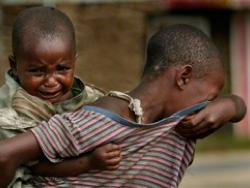
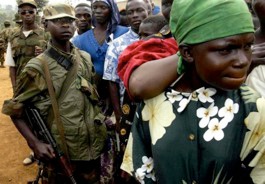
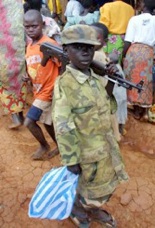
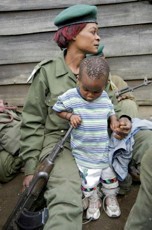
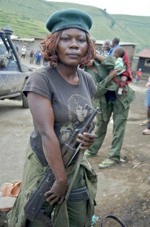
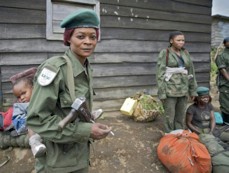
I saw many pictures as those I am attaching. I receive graphic pictures showing Hutu
women raped, then shot in private parts, burned afterwards or their limbs chopped off. I
receive pictures of young boys massacred. Those are graphic pictures that I choose not
keep. I also receive pictures like these below.
Pictures of Hutu kids who just saw their mothers raped and killed, their father killed
and their house burned or small Hutu boys forced into Tutsi armed groups and killing
their relatives, or women raped then killed or forced to take up weapons.
Felicien Kanyamibwa, PhD. April 5, 2009.
Massacres in Rutshuru, Kiwandja and Mweso
Sunday, April 5, 2009